Analysis options
The method, slices and tolerance, tension cracks, partial factors, and how to run, cancel and reset an analysis.
Open Model › Analysis › Options. The settings apply to the active model.
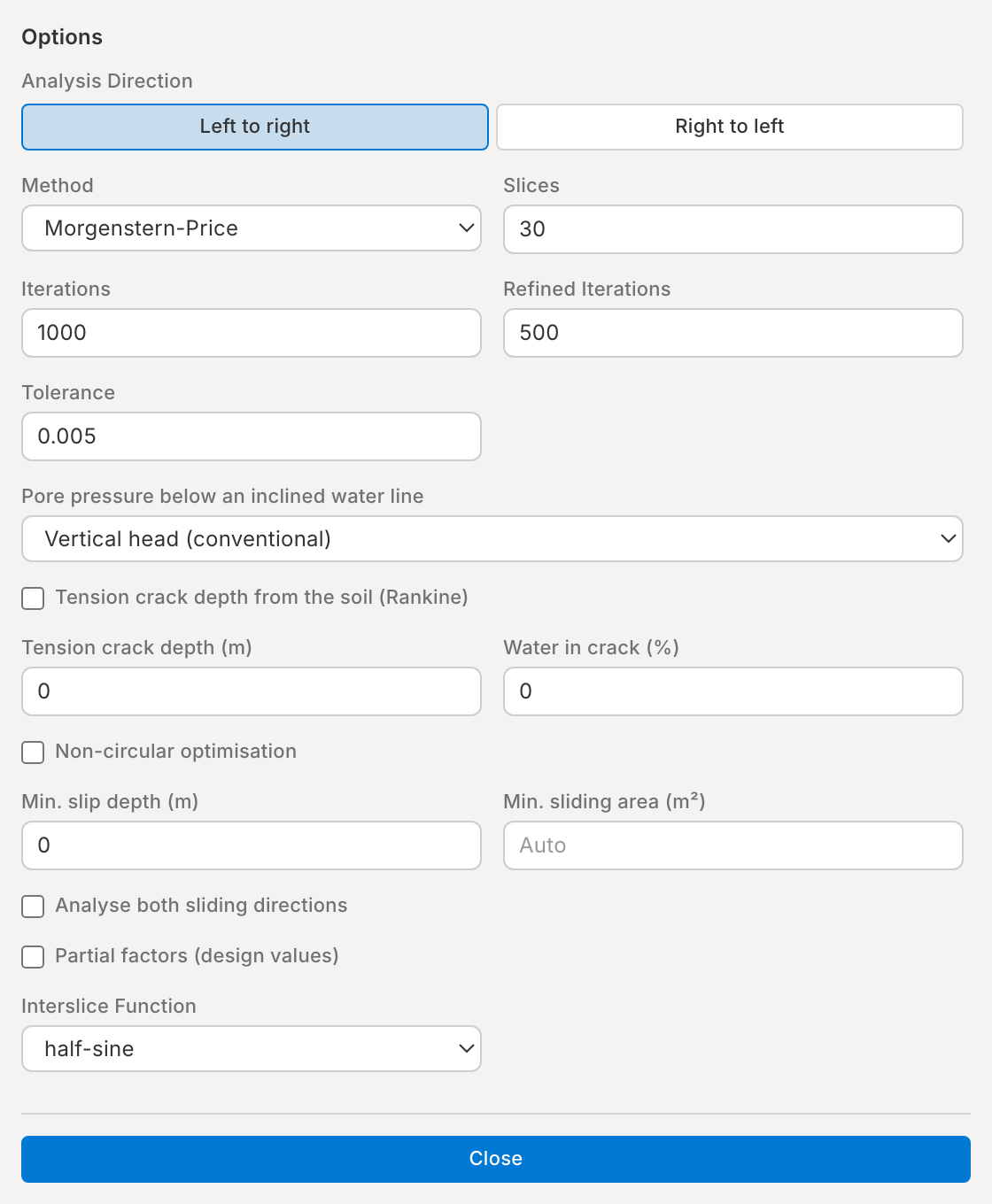
Method
| Setting | Options | Default |
|---|---|---|
| Method | Bishop, Janbu, Morgenstern-Price | Morgenstern-Price |
| Slices | 10–500 | 30 |
| Tolerance | 0.001–0.1 | 0.005 |
- Bishop: Bishop simplified (moment equilibrium).
- Janbu: Janbu simplified (force equilibrium). Tick Apply correction factor f0 to apply Janbu's correction.
- Morgenstern-Price: full equilibrium. Choose the Interslice Function:
constant(Spencer's method),half-sine(default),clipped-sine,trapezoidalordata-point-specified. For the last one, enter the points asx,f; x,fwith x from 0 (left end of the surface) to 1 (right end), for example0,0; 0.2,0.6; 0.5,1; 0.8,0.6; 1,0.
The theory page gives the equations. The Tolerance is the convergence limit on the factor of safety.
Tip
Thirty slices are enough for most slopes. With thin layers, a steep face or a tension crack, check that more slices do not change the result.
Tension crack
- Tension crack depth (m): a vertical crack at the upper end of the slip surface, in which the soil carries no shear. 0 means no crack.
- Tension crack depth from the soil (Rankine): compute the depth from the strength at the crest, , instead of entering it. The depth field then shows Auto.
- Water in crack (%): how full the crack is with water, from 0 to 100 %. The water pushes on the sliding mass.
Partial factors
Tick Partial factors (design values) for a design check with partial factors. The strength parameters are divided by their factors and the loads multiplied by theirs before the analysis:
| Factor | Applies to | Swedish practice (EKS/IEG) | EN 1997-1 DA3, M2 |
|---|---|---|---|
| γcu | Undrained shear strength | 1.5 | 1.4 |
| γc' | Effective cohesion | 1.3 | 1.25 |
| γφ' | tan φ' | 1.3 | 1.25 |
| γQ | Distributed and line loads | 1.3 | 1.3 |
Ticking the box fills in the Swedish set at once. Choose another set from Preset… or enter the factors yourself.
Which factor applies depends on the material. Undrained models, and Mohr-Coulomb materials with φ = 0, are treated as undrained and take γcu. For lime-cement columns the strength of soil and columns, including c′ of the columns, takes γcu, and tan φ′ of the columns takes γφ′. Other materials take γc' and γφ'. With partial factors the result is an over-design factor on the design values: 1.0 or more means the design is satisfied. The summary shows it as Min FOS (design values).
Pore pressure
Pore pressure below an inclined water line: Vertical head (conventional) or Phreatic correction. See Water.
Search
Iterations, direction, minimum depth and area, and non-circular optimisation are described in Slip surface search.
Running the analysis
Click ▶ Run on the floating toolbar. cSlope analyses the active model in the background and switches to result mode when it is done. The status bar shows Analysing... meanwhile, and the button becomes ■ Cancel.
The menu next to Run has:
- Run all: analyse every model in the project, several at a time.
- Reset: clear the result of the active model and return to edit mode.
- Reset all: clear all results.
If the model has a problem, for example an expression that cannot be evaluated, the analysis does not start and a message says why. If the analysis fails, the result summary shows the reason. A very large search stops after a time limit that grows with the number of iterations.
Note
Changing anything that affects the analysis clears the model's result, so a result always belongs to the model as it is.