Water
Piezometric lines, a line per material, ponded water above the ground, and how pore pressure is computed.
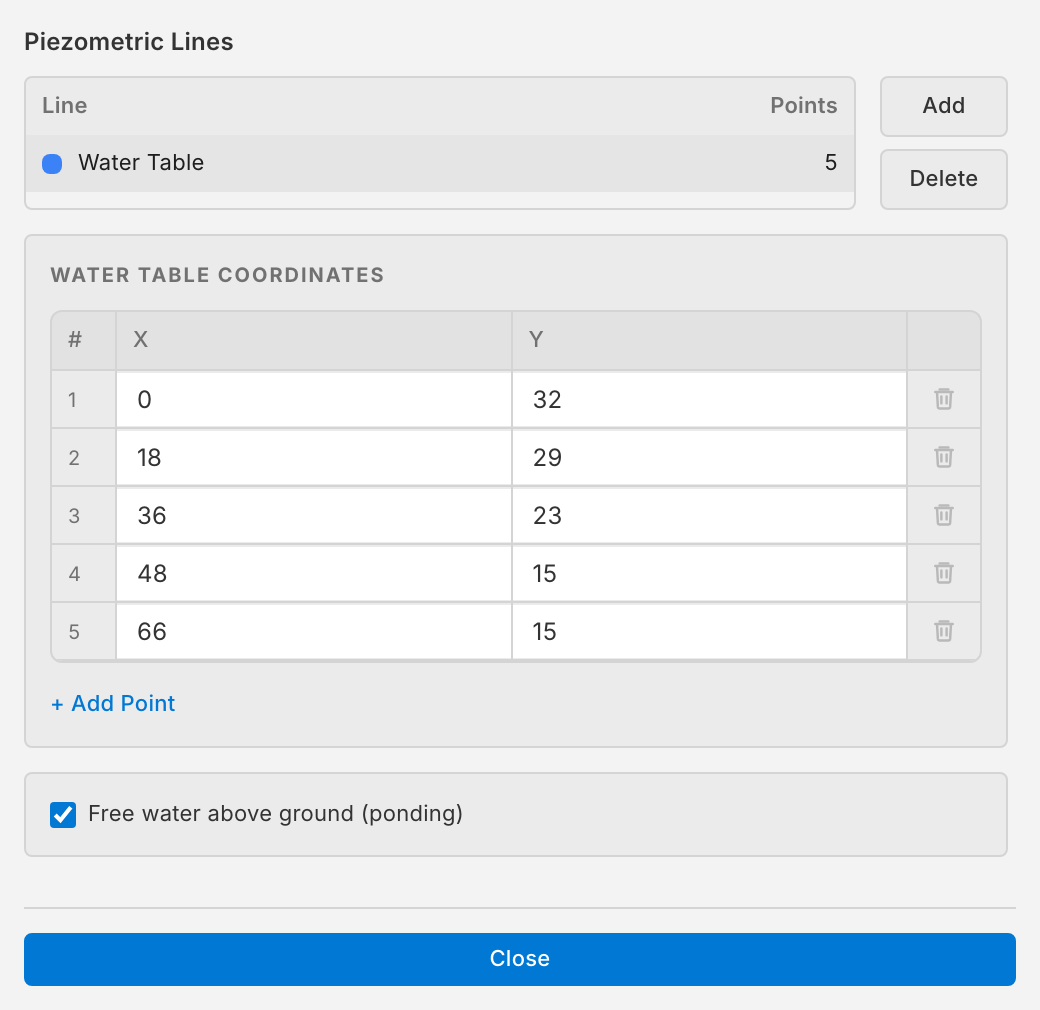
Pore pressures in cSlope come from piezometric lines. Open Model › Water Pressure › Piezometric Lines.
Adding a line
Add creates a horizontal line across the model at mid-height, named Line 1, Line 2 and so on. Select a line in the list to edit its points in the table below, or drag its points on the canvas. Right-click a line on the canvas to add a point, or a point to delete it. A line keeps at least two points. Delete removes the selected line.
Water is part of the analysis as soon as one line exists. Without a line the analysis is dry.
Pore pressure
At a point below a piezometric line, the pore pressure is
with and the pressure head. Above the line the pore pressure is zero.
How is measured is set in Model › Analysis › Options, under Pore pressure below an inclined water line:
- Vertical head (conventional), the default: the vertical distance from the point up to the line.
- Phreatic correction (vertical head × cos²θ): the vertical distance multiplied by cos²θ, where θ is the inclination of the line. This assumes a free phreatic surface with flow parallel to it and gives lower pore pressures below a steep line.
Several lines
With two or more lines, the window shows two more settings:
- Main line: the line that gives the pore pressure of materials without a line of their own, and the free water above the ground. By default the first line.
- Material Assignment: one line per material. Use it for perched water tables or a separate pressure level in an aquifer below a clay layer.
A material's line is also the level below which its saturated unit weight applies.
Free water above the ground
Free water above ground (ponding) is on by default. Where the main line lies above the ground surface, for example at the toe of a slope in a river or a reservoir, the water stands on the slope. Its weight acts on the slices below it, and against a vertical face it pushes horizontally. This is the usual way to model a submerged toe or a full reservoir.
With the box unticked, the lines are clipped to the ground surface and no water stands on the slope.
Note
A fully submerged slope gives the same factor of safety as the same slope in the dry with buoyant unit weights. This is one of the checks in the verification.
Water in a tension crack
A tension crack can be partly or fully filled with water. The water pushes on the sliding mass. Set it with Water in crack (%) in the analysis options; see Tension cracks.