Materials
The material models cSlope offers, their properties, and the saturated unit weight below the water table.
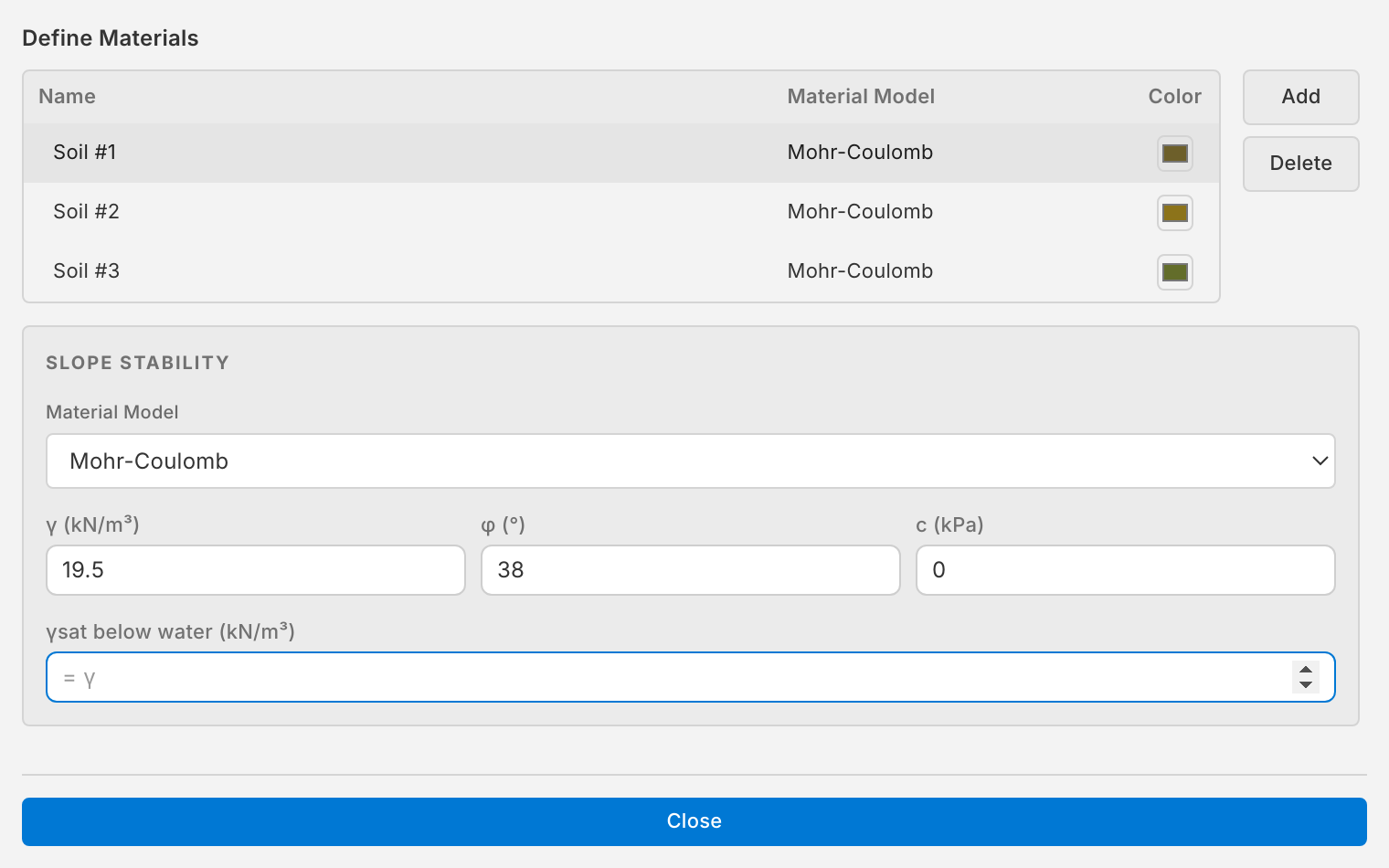
Open Model › Materials › Define. The table at the top lists the materials with their name, model and colour. Add creates a material; Delete removes the selected one (the last material cannot be deleted). Select a material to edit its properties below the table.
Every numeric property accepts a number or an expression with parameters, and a comma as the decimal separator. Problems with the input are listed in red under the form.
Material models
Choose the model in the Material Model list. Changing the model resets the strength properties to that model's defaults and keeps the unit weights.
| Model | Properties | Use for |
|---|---|---|
| Mohr-Coulomb | γ (kN/m³), φ (°), c (kPa) | Drained analyses with effective strength parameters. |
| Undrained | γ, Su (kPa), Max Su (cutoff) | Clay with a constant undrained shear strength. |
| S = f(depth) | γ, Su ref, Depth ref, Rate (kPa/m), Depth measured from, Max Su | Undrained strength increasing with depth below the ground or below the top of the layer. |
| S = f(datum) | γ, Su ref, Y ref, Rate, Max Su | Undrained strength that varies with elevation. |
| Anisotropic Function | γ, φ, c, modifier table | Strength that depends on the inclination of the slip surface. |
| Spatial Mohr-Coulomb | γ, interpolation, data points | Strength that varies from point to point in the section. |
| Lime-cement columns | γ, area ratio, soil and column strengths | Ground improved with lime-cement columns. |
| High Strength | γ | Strong material that may lie in the sliding mass; slip surfaces may not run through it. |
| Impenetrable (Bedrock) | γ | Material slip surfaces cannot enter. |
For the undrained models the friction angle is zero and the strength at the base of each slice is the undrained shear strength .
Mohr-Coulomb
The shear strength is , with the effective normal stress from the slice weight and the pore pressure. A new material is Mohr-Coulomb with γ = 20 kN/m³, c = 10 kPa and φ = 30°.
Undrained
A constant undrained shear strength Su.
S = f(depth)
where is the depth of the point and the Depth ref. Depth measured from chooses where the depth starts:
- Top of layer (default): the depth below the top of this material's layer above the slice. A layer that lies below other layers then starts at Su ref at its own top.
- Ground surface: the depth below the ground surface.
S = f(datum)
where is the elevation of the point and the datum. A positive rate makes increase with depth below the datum.
Strength cutoff
The undrained models and lime-cement columns have a Max Su (cutoff). Leave it empty for no cutoff. When the strength is constant or increases with depth, the cutoff is a maximum; when the rate is negative, it is a minimum, so that the strength never falls below it.
Anisotropic Function
Mohr-Coulomb strength in which c and φ are both multiplied by a factor that depends on the inclination α of the slice base, measured relative to the sliding direction. Enter the factors as a table of α (°) and factor; cSlope interpolates between the rows.
Spatial Mohr-Coulomb
c, φ and γ given at data points (X, Y). Between the points cSlope interpolates by IDW (inverse distance weighting, power 2), Linear (inverse distance weighting, power 1) or Nearest (the value of the nearest point).
Lime-cement columns
The strength of the improved ground is the area-weighted strength of the columns and the soil between them:
where Area ratio a is the share of the area taken by columns (0–1). The soil strength is Su soil, increasing by Su soil increase per metre below Su soil at level; the column strength is Su columns. Tick Drained limit of the column strength to also limit the column strength by drained parameters c′ columns and φ′ columns. The cutoff applies to the soil between the columns only. With partial factors, the strength of soil and columns (including c′ columns) is divided by γcu and tan φ′ columns by γφ′.
High Strength and Bedrock
High Strength material is so strong that the slip surface cannot run through it: a surface with a slice base in it is not analysed. The material can lie inside the sliding mass, above the slip surface, where it adds its weight. Impenetrable (Bedrock) stops slip surfaces: a surface that would enter it is not analysed. Both are drawn with a hatch on the canvas (HS and BR).
Saturated unit weight
Every model except Bedrock has a γsat below water field. Below the material's piezometric line, the soil then weighs γsat instead of γ. Leave it empty to use γ throughout.
Colours
Each material has a colour, used for its regions on the canvas, in the material table and in exports. Click the colour in the table to change it. Soil colors on the Results tab hides the colours in the result view.